%20(2).png)

Teams need Trust and Coaching is a Team Activity
by Dr Tim Williams
Have you ever had a coaching client who did not appear to be paying attention to their results? Or others where there seems to be a lack of accountability or commitment to the goals ‘they‘ set?
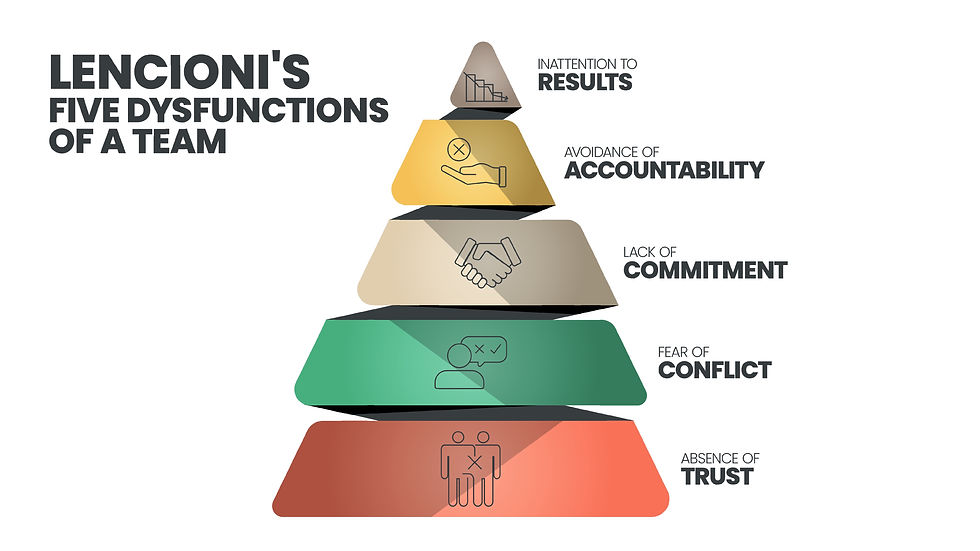
If we see the coaching relationship through the lens of a team with coach and client as team players, Patrick Lencioni’s 5 dysfunctions of a team (above), may offer some insight.
5 Dysfunctions of a Team
In poorly performing teams, Lencioni identifies a lack of trust as the foundation of the other dysfunctions. If you don’t trust in your teammates, then you’re unlikely to say what you really think, because you’re worried you might upset someone – fear of conflict. Because you don’t say what you think, decisions get made without your input and as a result, you lack commitment to the direction of travel. It is difficult to hold someone accountable for something they have not committed to and so, unsurprisingly, they don’t pay attention to the results of the team. Rather they disengage and focus instead on their own projects and prioritise those.
1:1 Coaching as a team Activity
This might also sound familiar in a 1:1 coaching relationship. In supervision, clients are often presented as lacking commitment or accountability or simply being unmotivated and the coach wants to know what they can do about it.
When we find ourselves in this situation (and we will), then my encouragement is to:
1. Consider how much trust we have created between ourselves and our client and whether we need to step back and spend more time doing this. In my experience, trust is built by taking time to understand, even more, about that client’s life and context. Spending precious time connecting at the start of a coaching relationship and at the start of each session, is time well spent.
2. Check I have created an environment where my client can speak their mind freely, and say what they really think, without fear of judgement– even if they disagree with us? This might require more time re-contracting to emphasise the importance of welcoming different perspectives and being courageous enough to articulate them.
3. Revisit the goals and check whether are really centred on what matters most to the client right now and not around what they think they should do. People’s situations change and so will their priorities, so let’s not assume that the goal they started with, is what is important now.
I would suggest that it is not until we have considered all of these, that we might then question a client’s commitment or motivation and what WE (together) can do about it. In my experience, if a client appears unmotivated or uncommitted, there is often a really good reason. Let’s not let that reason be, that they don’t trust us enough to share what really matters, or let us know that they disagree, or set goals that are not meaningful to them right now.



If your notes keep scattering across apps, having a single place to write and link pages can make it easier to keep everything within reach.
This article highlights trust as the foundation of effective teams and coaching should be treated as a shared activity rather than a top-down process. It connects leadership with collaboration and accountability. When reflecting on my own writing, I even used the Free Word Counter Tool to keep my thoughts concise and clear. It’s a practical reminder that strong teams grow through continuous coaching, communication, and mutual trust.
Very insightful. As usual applicable in lots of other situations - General Practice is a team working environment and needs these fundamentals in place to be successful.